
Alleghany Release Date Stages
A projected or expected release date is a calculation. It reflects the sentence information and credit data available at the time. An advance notice says that release is anticipated. The final level is the actual custody event, supported by the custodian’s release entry or signed release papers. A future date on a locator cannot prove that the person left, and a date that has passed without a status change should prompt a call to the custodian rather than a declaration of release.
Pretrial custody works differently. The person has not yet reached a final sentence, so there may be no sentence-based release date to compute. A bond decision or dismissal may create legal authority to leave, but processing, conditions, another case, or a detainer can keep the person in custody. At Alleghany County Regional Jail, the actual movement entry answers when the person left that facility and whether the destination was the community or another authority.
Find an Alleghany Release Date
Start with the system that owns the sentence. A state-responsible sentence belongs in the VADOC path even if the person remains for a time in a local or regional jail. A short local sentence may be computed by the sheriff or another responsible time authority. The court supplies the sentence and jail-credit orders, but the court docket alone may not reflect the minute when physical custody ended.
- Identify whether the person is pretrial, serving a local sentence, or serving state-responsible time.
- For state custody, search the VADOC locator by seven-digit DOC ID or by the required name fields and compare identifiers.
- Read the release-date field shown on the current result, if present, without substituting an older internal label.
- For Alleghany jail time, ask the jail or responsible computation authority about the projected date and credited time.
- Check the sentencing court for the term, jail-credit orders, later amendments, and other active matters.
- Confirm the actual event through the release entry, updated status, or signed release papers.
The Alleghany County release-record search is useful after a date passes because it joins the jail movement, court authority, and state or federal status paths. A no-result screen does not supply a discharge date. It can mean a poor match, final discharge outside the locator’s stated scope, delayed data, or the wrong custody system.
Note: Use the DOC ID when available because it reduces same-name errors and follows the state record across facility moves.
VADOC Alleghany Release Lookup
The VADOC Inmate and Supervisee Locator covers people incarcerated in state institutions and active probationers or parolees supervised through district offices, along with other stated groups under VADOC authority. Search with at least the first three letters of the first name and the full last name, or use the seven-digit DOC ID. Optional filters include location, race, gender, and age range. VADOC says the data is updated daily and warns that it can be inaccurate or out of date.
| Search element | How to use it |
|---|---|
| First and last name | Use the required name format, then broaden carefully if no match appears. |
| Seven-digit DOC ID | Best single key for reducing a same-name mismatch. |
| Optional filters | Location, race, gender, and age range can narrow a large result set. |
| Current location or status | Helps distinguish secure custody from active community supervision. |
| Current release-date field | A computation if displayed, not proof that release occurred. |
The exact public date label remains a live-screen fact. VADOC internal materials have used several date names, but those must not be presented as the current public interface without verification. Preserve the label shown on the selected result and the date of the check.
Virginia Time Computation Rules
The official VADOC Time Computation page identifies which authority calculates time and the sentence factors that enter the process.
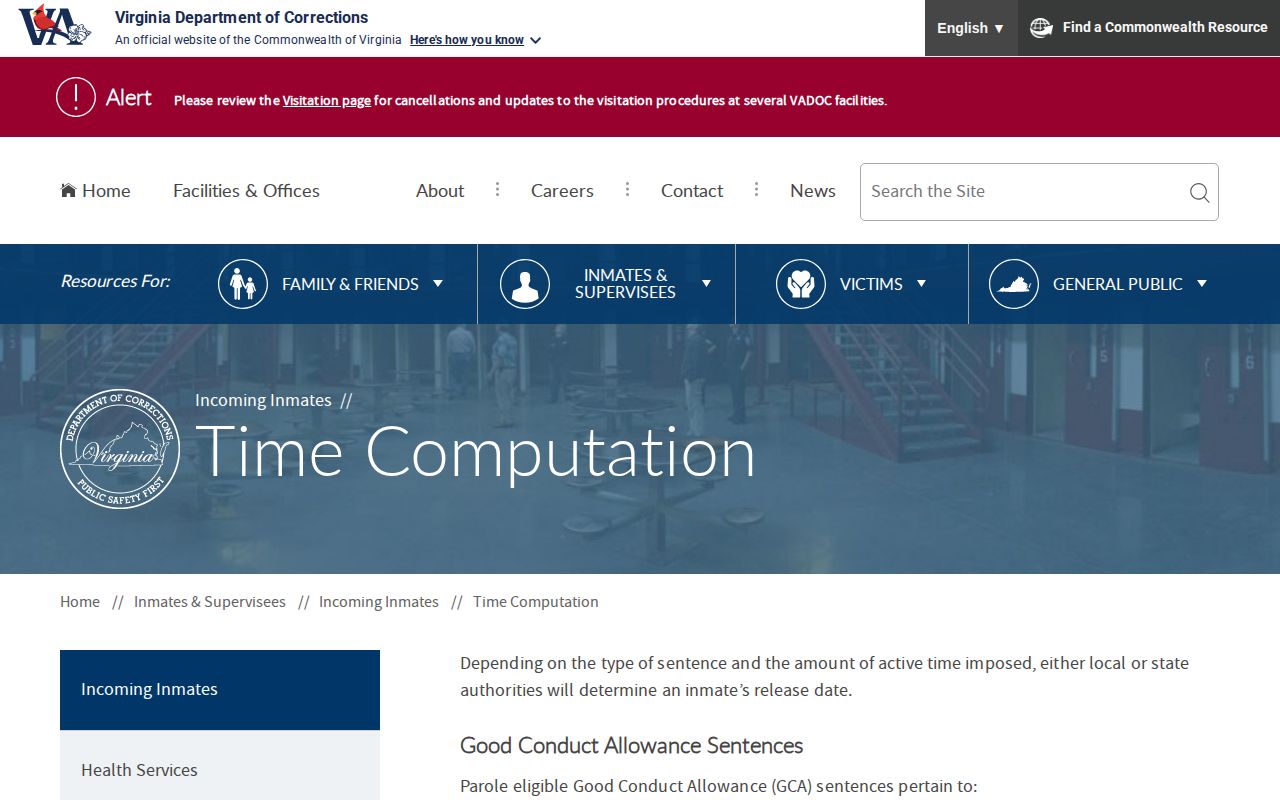
The captured agency page reinforces why a pronounced term cannot always be reduced to calendar subtraction. Pre-reception jail credit, sentence type, total active time, earned-credit level, disciplinary history, and later computation events can all matter.
Alleghany Earned Release Credits
Virginia law calls an earned sentence credit a deduction from confinement. Under Virginia Code § 53.1-202.2, one credit equals one day. The rates and eligibility categories appear in § 53.1-202.3. For offenses listed in subsection A, the maximum is 4.5 credits for each 30 days served. At that maximum, 30 physical days satisfy 34.5 sentence days, or about 86.96 percent physical service. It is inaccurate to call every Virginia term a universal “85 percent sentence.”
Other eligible offenses can fall within a class system that permits up to 15, 7.5, 3.5, or zero credit days per 30 days served, depending on statutory and program rules. A lower earning level or lost credit can move the estimate later. Amendments and future effective versions also matter, so the controlling law must match the offense and calculation period rather than the date of a casual web search.
Older parole-eligible sentences may use good-conduct allowances and mandatory-parole calculations under a different statutory framework. The current maximum earned-credit rate should never be applied to such a sentence without checking which system governs. “Good time” is a broad phrase; earned sentence credit is the specific deduction defined by the current statute.
Why Alleghany Release Dates Move
A date changes when the legal inputs or the credit record changes. Some events alter the computation itself. Others do not change the sentence but block release to the community. The distinction is vital because a person can complete one term and still transfer to another custodian.
| Factor | Effect on the date or exit |
|---|---|
| Corrected jail credit | Changes the amount of pre-reception time applied to the sentence. |
| Earned-credit level | A higher or lower lawful earning rate changes projected completion. |
| Disciplinary action | May reduce credits or change the class used in the calculation. |
| New or amended court order | Can change the sentence term, concurrency, or credited time. |
| Uncalculated sentence | Can prevent staff from treating the visible term as complete. |
| Warrant or detainer | May send the person to another authority instead of the community. |
| Parole action | A grant can authorize a release process, but does not prove the door opened that day. |
VADOC Operating Procedure 050.3 calls for records checks involving warrants, detainers, court orders, discipline affecting time, and uncalculated sentences. These checks occur because a single date field cannot reflect every last-minute legal barrier. For a local Alleghany sentence, ask the jail or responsible computation authority to confirm both the credit and the actual discharge.
Note: A detainer is another authority’s hold; release from one sentence may therefore become a transfer instead of freedom.
Local Versus State Release
Alleghany County Regional Jail holds both pretrial and sentenced local prisoners, and state-responsible prisoners may remain temporarily in a local or regional jail. The building does not determine who computes the sentence. For state-responsible active time, VADOC may perform the calculation even before a facility move. For a local sentence, the sheriff or responsible local computation authority should confirm credit and discharge. In either path, the court supplies the judgment and jail-credit orders.
- Projected date
- A calculated date that may change when legal or credit inputs change.
- Discharge
- The formal end of the custodial sentence or other correctional authority described by the record.
- Parole
- Release from confinement under Parole Board authority for an eligible sentence, with supervision continuing.
- Detainer
- A hold or request from another authority that may cause transfer instead of community release.
A VADOC result showing District 40 community supervision can support that the person left secure state custody, but supervision means correctional authority continues. Final discharge may remove the person from the public locator’s stated active scope. At that point, release paperwork and the sentencing record are stronger historical sources than locator silence.
Alleghany Court Credit Evidence
The sentencing order and later court orders supply the legal term and any judicially awarded jail credit. Keep the case number, offense date, sentence date, active term, suspended portion, and credit language together. A felony may move from General District Court to Circuit Court under a different number, so an incomplete district summary should not be treated as the final sentencing record. Ask the clerk for the controlling order when the online case view omits the needed detail.
VADOC or the responsible jail applies those legal inputs through its computation process. A corrected order or previously missing credit can move the projected release date. Conversely, one case showing “time served” does not defeat another warrant, probation violation, sentence, or detainer. The court record explains authority in each case; the custodian must still confirm the combined calculation and actual exit.
Confirm Alleghany Actual Release
VADOC’s actual release process uses stronger records than an estimate. A person who has satisfied the sentence may receive a notification-of-release letter and sign the applicable Order of Release, Conditions of Probation, or Conditions of Parole. Staff witnesses and dates the paperwork. A local jail release entry should likewise record when the person left, the release type, authority, and destination.
For a pending local jail custody change, the Alleghany VINELink release check can provide an alert when the supplying jail reports an event. It still requires confirmation. Compare the alert with the jail movement record and relevant court order. For state custody, compare the public status after the event with VADOC release documents. If the receiving agency is named, follow that custody system before describing the event as community release.
A projected date is useful for planning a lawful pickup, court follow-up, or reconnection. Its proper use depends on the label remaining honest. Write “projected” until the custodian records the event, and write “transferred” when the destination is another jail, VADOC, ICE, the U.S. Marshals, or another holding authority.
Note: When a displayed date passes without a status change, contact the custodian and do not infer release from the calendar alone.